Focado em Elétrica, Eletrônica, Telecomunicações e Automação Industrial.
(Focused on Electrical, Electronics, Telecommunications and Industrial Automation).
New White Paper - A single Snapshot for Whole-Organoid Screening
APPLICATION NOTE Capturing the whole organoid in a single shot
Dear Researcher,
If you screen drug response in 3D organoid models, you know the trade-off well. Image each organoid in full 3D and a whole plate can take a very long time; flatten it to a single 2D plane and you lose the very morphology that made a 3D model worth using.
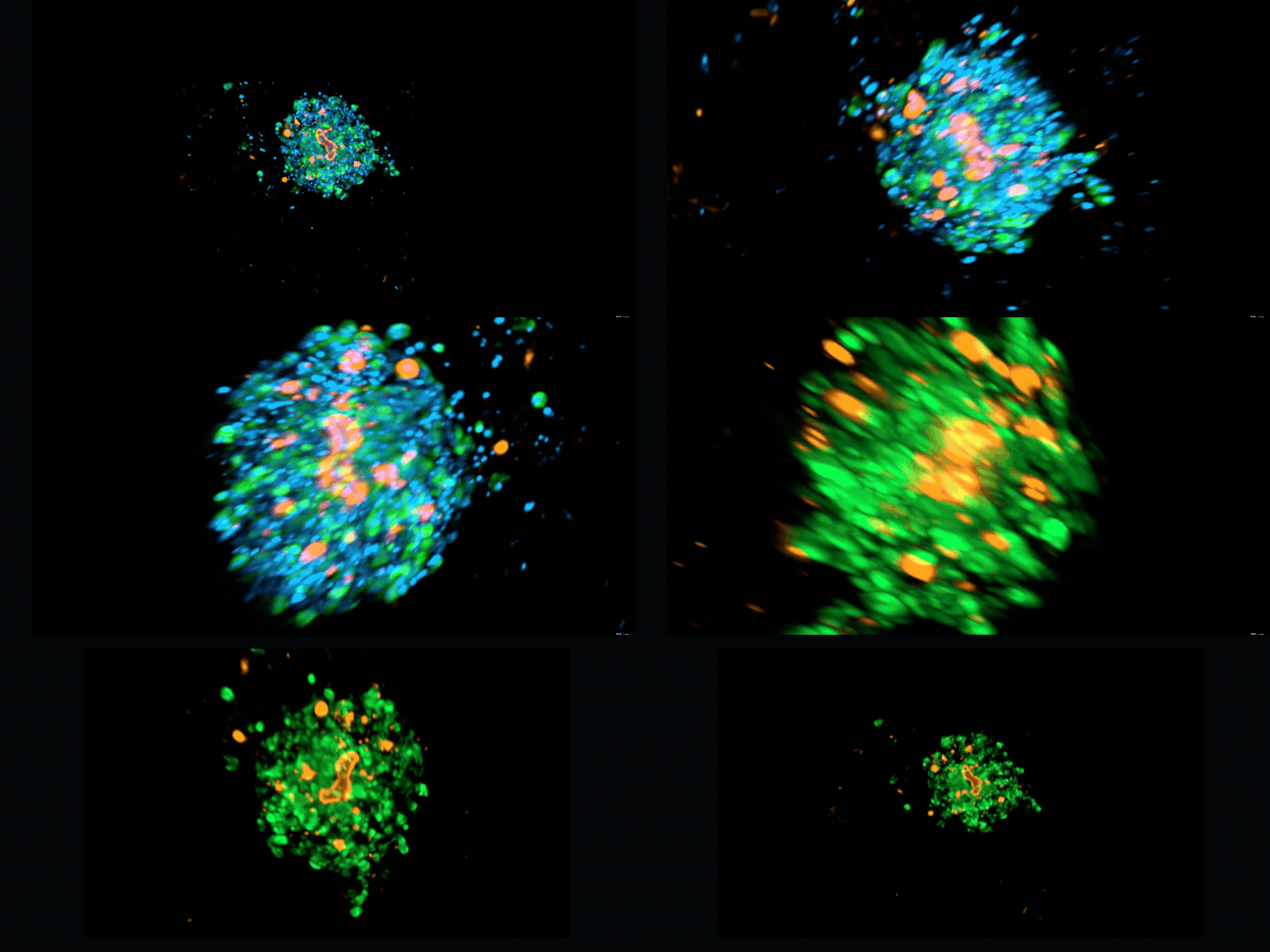
We are excited to share an application note we recently published with InSphero that offers a way around this. Using the ZEISS LSM 990 with Lightfield 4D, we captured the entire volume of each organoid in a single snapshot — no serial z-stacking — and ran quantitative drug-response screening across a full 384-well plate.
A few results stood out. Colorectal tumor–stroma co-cultures treated with the topoisomerase inhibitor SN-38 showed a clear, dose-dependent loss of tumor cells — roughly 57% at the highest dose — while the surrounding stroma held steady, pointing to a tumor-directed effect. And because the whole volume is already captured, we could analyze the same data in true 3D and recover 2–2.5× more cells than a 2D projection would, with no cost to throughput. Wells worth a closer look were simply re-imaged with Airyscan on the same instrument — no sample transfer needed.
1-Snap Full organoid volume, no z-stepping.
~57% Tumor-cell loss at 500 nM SN-38.
2-2.5x More cells counted in 3D vs. 2D.
It’s a short read, about nine minutes. If any of this is close to your work, I think you’ll find it worthwhile:
This work was carried out in collaboration with InSphero, whose Akura™ 384 ImagePro platform and reproducible tumor–stroma organoid co-cultures formed the biological basis of the study.
No seguimento do curso de Automação, neste artigo apresento como perceber os conceitos básicos de programação de um CLP. No decorrer das próximas edições apresentaremos a forma de programar um controlador lógico programável Autores: Filipe Pereira - Eng. Elétrotécnico / Automação Klean Energie 4 Life, Ltda Energias Renováveis - Portugal As linguagens de programação são empregadas nos CLPs desde que estes surgiram em 1960. Estas permitem ao usuário inserir programas de controle utilizando sintaxes pré-estabelecidas. Previamente ao estudo dos três tipos de linguagem mais utilizados na programação de CLPs, convém rever alguns conceitos essenciais. O programa que vai definir o automatismo é constituído por uma série de instruções e funções onde são operados os bits de memória. Estas instruções e funções, serão introduzidas na memória do CLP, através de um periférico destinado a esse fim e que poderá ser uma console de programação ou software específico para PC. Veja na figura 1 u...
By Jestine Yong on July 9, 2014 Almost any new device such as mobile phone, tablet, iPod, GPS etc… will come with some sort of USB Charger and a cable. The cable will connect to your device through a dedicated connector, mini USB, micro USB or manufacturer’s specific. At the other end, most cables will be terminated with the familiar USB connector (USB type A), which you can connect either to the charger or to your computer. If you are like the 50% of mobile phone users you will buy a second charger, just to have one at work and one at home. Over the years, you will end up with several USB chargers and you might wonder if you could simplify your life by having only one charger, or at least a couple of chargers, for all your devices. The problem is that they are not all compatible. Your Samsung charger will not work with your Apple device etc… In this article we will analyze some USB chargers and find out why they are so different. And may be find out that they are ...
By Jestine Yong on November 21, 2013 2 The problem of this receiver was a bad picture. In order to make sure that the LNB DISH and Signal Cable are working fine, I installed another good receiver to the end of the line and I received a very beautiful and sharp picture and this indicated the LNB dish all the way down to receiver were working fine. This means the problem for sure is the receiver set. Note: LNB stands for low-noise block and the function is to receive the very low level microwave signal from the satellite, amplifies it, changes the signals to a lower frequency band and sends them down the cable to the indoor receiver unit. After opening the cover, the first thing I checked was the output voltages from power supply. More or less all of the output voltages readings were within tolerance: 5 v was 5.17 3.3 ” ...